
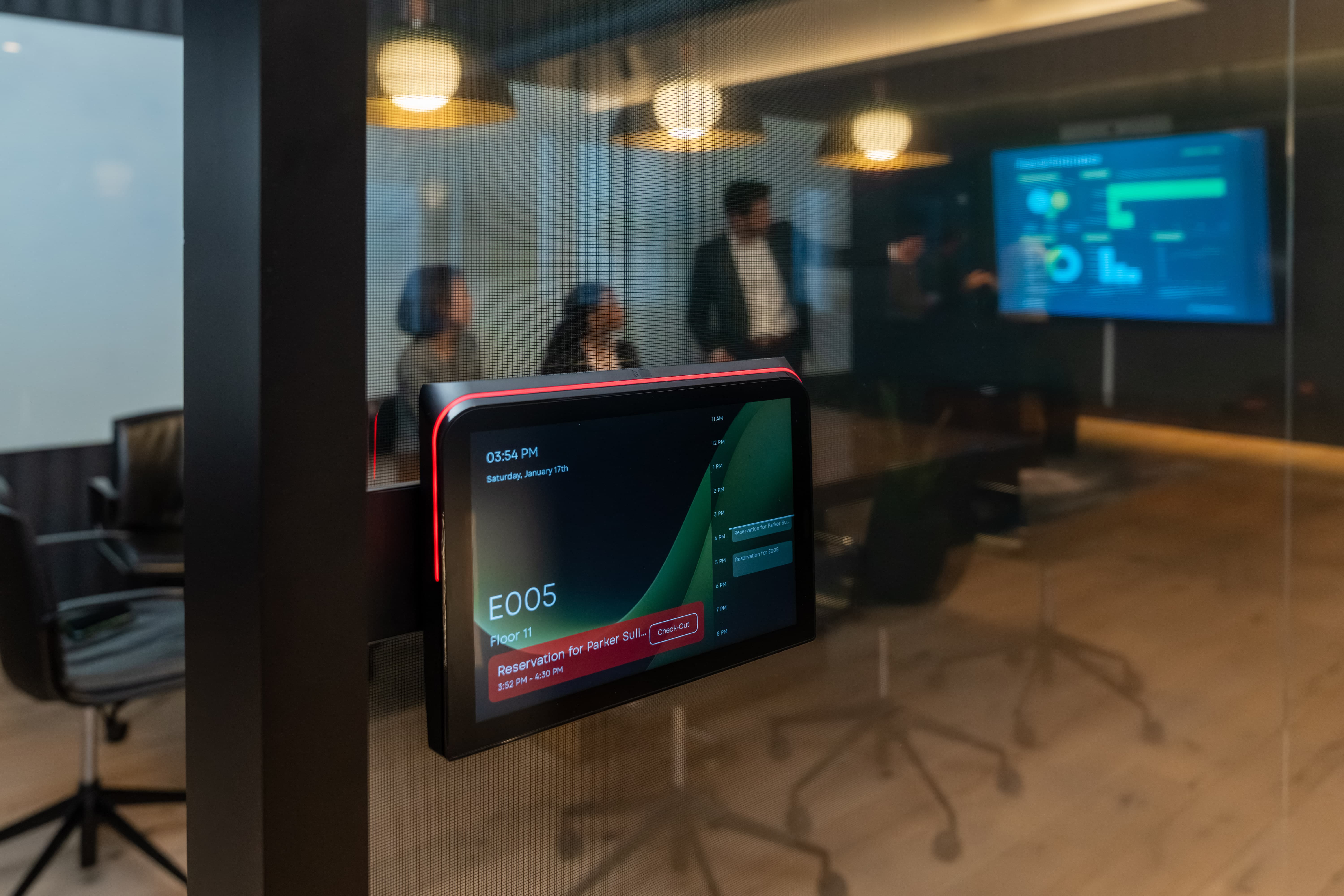
Ghost booking is Embrava's term for a familiar problem: a room that's reserved and empty. Nobody shows up, but the room still reads as taken, so a team looking for space to collaborate walks right past a door that could have been theirs. Multiply that across a floor, and an office that has plenty of room can start to feel like it doesn't. Across 42 customer rollouts, real-time room signs and check-in have cut ghost booking by 78% on average.
It's also a space utilization software problem hiding as a scheduling problem. Booking data can only tell you what was reserved, not what actually happened in the room. Closing that gap takes real-time visibility at the room itself, on top of the booking platform your team already runs.
Here are five practical ways to cut down on ghost booking and get that space, and that data, back.
1. Require room check-in.
Have employees check in when they arrive, with a room sign, a mobile credential, or a badge. If nobody checks in, the room is free to release. This works on top of whatever booking platform you're already running, OfficeSpace and Eptura both support check-in-triggered release, for example, the room sign is what makes that check-in physical and visible at the door.
2. Automatically release unused rooms.
Set a short grace period, 10 to 15 minutes is typical. If the organizer never checks in, the reservation cancels automatically and the room opens back up.
3. Make it easy to cancel what's no longer needed.
Plans change. A quick cancellation frees the room for someone else instead of holding a no-show reservation all day.
4. Let the data show the pattern.
Booking analytics surface which rooms get reserved often but used rarely, exactly the meeting room utilization signal workplace teams need to fix policy, not guesswork.
5. Make availability visible in real time.
A room sign that shows available, reserved, or occupied at a glance means employees can find space fast, and are less likely to book a room "just in case." It's also what turns your booking platform's data from a schedule into a source of truth, since the sign reflects what's actually happening in the room, not just what was reserved.
The bottom line.
Your booking platform already knows what was reserved. Room Sign is what tells it what actually happened, so the space utilization software data behind it is worth trusting.