
EVENT INSIGHTS
Beyond the Booking: Lessons from Legal Workplace26 London
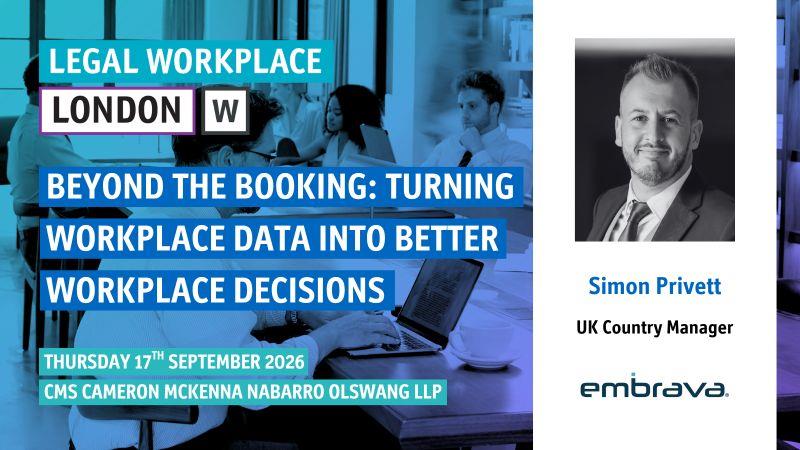
Most of us have experienced this. You open your booking system, the floor looks full, and yet when you walk in on the day, half the desks are empty. I opened my session at Legal Workplace26 London with that familiar situation because almost everyone recognises it, and because that same gap between what was booked and what happened can sit behind some very expensive property decisions.
On 17 September 2026, Embrava joined WORKTECH's Legal Workplace26 London as a Silver Sponsor. Hosted by CMS at its Cannon Place offices, the event brought together property, facilities and workplace leaders from across the legal sector. My session, "Beyond the Booking: Turning Workplace Data into Better Workplace Decisions", explored why booking data alone can easily give an incomplete picture of how space is used, and what firms can do to make better informed workplace and property decisions.
That question sits at the heart of what we do. Embrava connects the booking and workplace systems firms already use with the desks and meeting rooms where people work, making the right information visible at the moment someone needs to act on it. Spending the day with the people responsible for shaping the legal workplace gave me the opportunity not only to put that idea in front of them, but also to hear first-hand the challenges they are working through.
The problem is a shortage of truth
The point I wanted the audience to take away was simple: when a booking system shows a full office, but the floor looks half empty, the data is often answering a different question from the one being asked. In that situation a firm may not have a shortage of space - but rather a shortage of truth.
To illustrate the point, I used deliberately simple numbers. Imagine a booking system reporting 70% occupancy, while turnstile data suggests that closer to 45% of people entered the building. Those figures were illustrative rather than findings from any particular firm, but the gap they represent is a familiar one. That distinction matters. When differences like this feed into decisions on a ten-year lease, a relocation or an office redesign, millions of pounds of real estate investment end up resting on assumptions, rather thana clear picture of utilsation.
I explained the gap through three things that are often treated as though they are the same.
Intent
The booking. It records the plan someone made on Sunday evening for Tuesday morning, before the week had a chance to change it.
Presence
Whether they arrived. A badge or mobile credential at the turnstile confirms that someone entered the building. It does not show which desk or meeting room they used.
Behaviour
What happened in the space. Did a boardroom booked for twelve, hold twelve people or three? Did the meeting finish early, leaving the room reserved but empty for another hour?
Many organisations measure only the first of these. Hybrid working makes the problem more visible demand is so heavily concentrated between Tuesday and Thursday. The booking dashboard can suggest a shortage across those three days, while at other points in the week whole areas of the office are heated and lit for relatively few people. At the same time, an associate can find themselves walking the corridor looking for somewhere to take a call, because the calendar is full of room bookings nobody is using.
The answer I put to the room was not to rip out existing systems. The bigger issue is that those systems often operate in isolation. Booking data show intent. Check in at a desk or meeting room confirms that someone arrived at the space they reserved. Occupancy sensors, where they are used, show how that space was used over time. Bring those signals together and a firm has a far more accurate basis for deciding how much space it needs, how that space should be configured, and where investment should go.
What we heard from the wider programme
Several sessions returned to the same underlying tension from different directions. Three in particular stayed with me.
Attendance data can size a building, but it cannot guide people on the day
Andrew Dacombe, Founder and CEO of Silverstorm Consulting, joined Ben Munn of UnWork to discuss the technology workstream behind a global law firm's move into a new London headquarters with a significantly smaller footprint. Andrew described how several years of building entry data was used to see which days were busiest and how many people were coming into the office. One detail stood out: the busiest days across the previous three years were the days of the summer party. As he put it, the office has to earn the commute.
That data gave the firm confidence that the new building could accommodate everyone, despite having fewer desks than before. Yet the question employees asked Andrew more than any other was whether they would still have a desk. The harder question, he acknowledged, is whether it will be the desk someone wants, in a neighbourhood they know. Building attendance can tell a firm how much space it needs. It cannot help a an individual understand where to go when they arrive. That information must be visible at the point people need it.
Andrew also cautioned against drawing conclusions from the first six months in a new building. Curiosity, novelty and visiting colleagues can all inflate early attendance in his view, months seven to twelve provide a much more representative picture of how the workplace will ultimately be used. For anyone reviewing workplace performance after a move, that is a useful discipline: resolve operational issues quickly, and judge long term utilisation once behaviour has had time to settle.
Utilisation data is trusted, but it explains only part of the value
Sarah Brooks, Associate Director in World Research at Savills, presented findings from a survey of more than 240 real estate and workplace leaders on how organisations measure the value of the office. Utilisation and occupancy data were among the most widely used measures, and among those that respondents trusted most. Her caution was that occupancy data shows whether people are coming, but not the whole story. Experience data helps explain why people choose to come in, while business measures begin to show whether the investment is contributing to performance. The organisations furthest ahead were bringing those different data sets together, rather than relying on any one in isolation
She also made a point that is particularly relevant in a law firm. Lawyers account for their time in six-minute units, so the ability to find a meeting room quickly, locate an available desk or flag an operational issue matters. If people cannot trust what a room or desk display is telling them, the cost is measured in not only poor property decisions, but also in lost fee-earner time.
A room can be empty because it is the wrong room
During the afternoon panel on the intelligent legal workplace, one panelist described creating smaller, dedicated meeting rooms for two or three people, with a particular focus on acoustic privacy. Rooms that had worked well when the office was busier had started to reveal sound leakage once the surround environment became quieter.
That matters when interpreting utilization data. A low figure is not always a signal that a space should be removed or repurposed. A room may be underused because people do not consider it suitable for a confidential conversation. The data can reveal the pattern; understanding the reason behind it still requires walking the floor, observing how the space is being used, and speaking to the people who use it.
Where Embrava fits
The common thread for me across those sessions was the gap between what a system records and what someone experiences when they arrive at a desk or a meeting room. That is the gap Embrava is designed to help close.
Desk Sign brings live booking information to the workstation itself. Connected to a supported booking platform, it shows whether a desk is available, reserved or in use. Users can check in with a badge, a phone, a QR code or via the display itself.
Room Sign does the same at the meeting room., It shows current availability and upcoming bookings, with a visible status people can be read from across the floor. Users can check in, extend or release a reservation at the door, or take an available room on the spot for an ad-hoc conversation.
Embrava Connect Cloud sits behind those devices, managing them and connecting them with the workplace systems a firm already uses. Its workspace intelligence capabilities are designed to compare booking history with activity recorded by connected devices, helping workplace teams understand the difference between what was booked and what actually took place.
That is ultimately the point: not to replace the systems firms already rely on, but to build upon and make the information they hold more visible, more connected and more useful at the moment decisions are being made.
One thing to try before your next space decision
Pick one floor or one group of meeting rooms and compare what each data source tells you over the same period: bookings, building entries, check ins and, where available, measured occupancy. Where the sources disagree, walk the space and speak to the people using it. In many cases, the issue will turn out to be a combination of booking habits, check in and release rules, or spaces that do not suit the work taking place in them, rather than a straightforward shortage of rooms or desks.
What I took from Legal Workplace26 London is that better workplace decisions start with asking each data source only the question it Is capable of answering. Thank you to WORKTECH and CMS for bringing the day together, and to everyone who spent time with the Embrava team.
Frequently Asked Questions
Next Step
If your booking system says the floor is full and the floor tells a different story, talk to us. Tell us which booking platform you use and where people experience friction and we can show you how Desk Sign, Room Sign and Embrava Connect Cloud can make availability, check in and workspace activity visible at the desk, the door, and to the teams making longer-term workplace decisions